
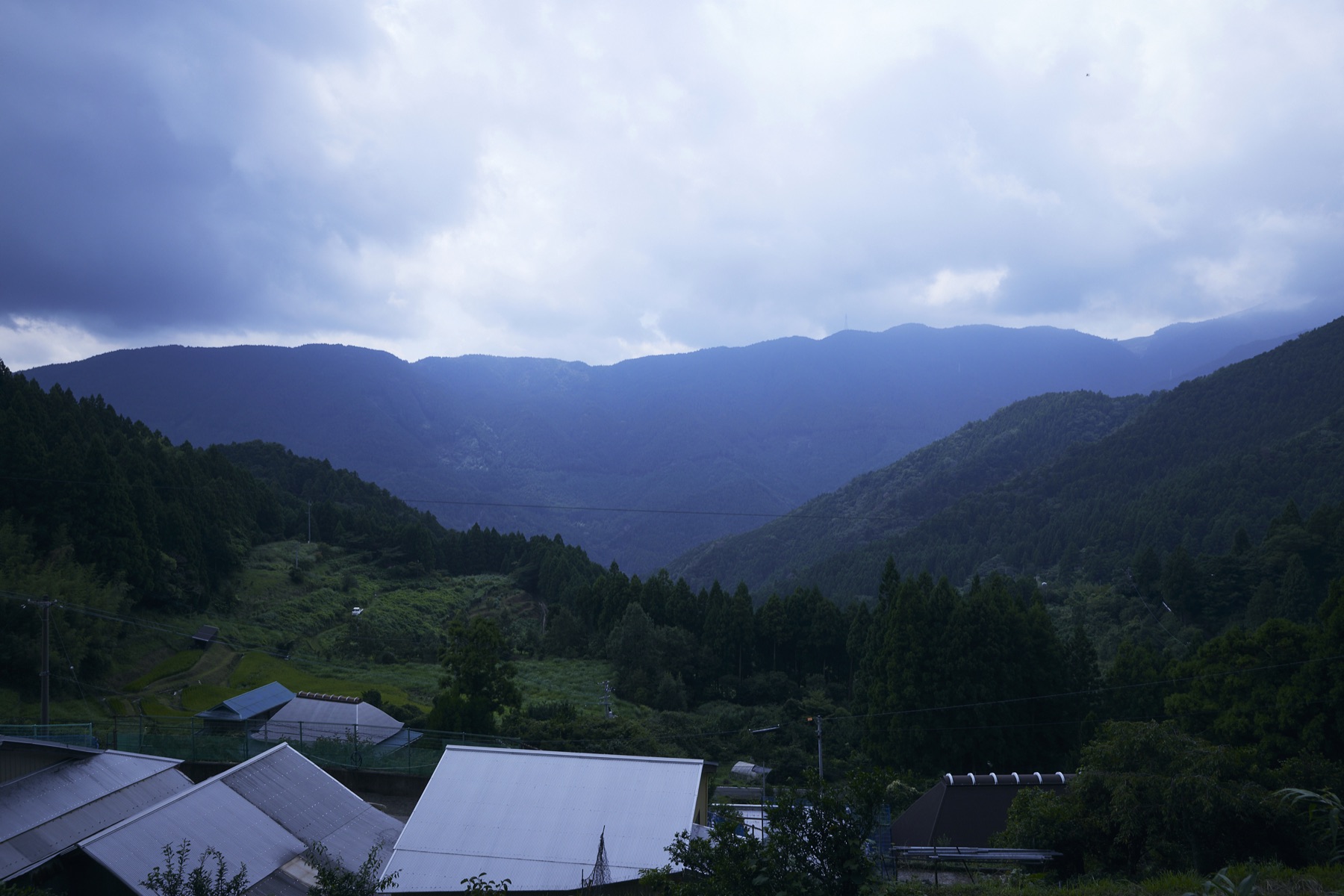
Before dawn. On the stone flagstones of Nakahechi, the most-walked of the six routes of the Kumano Kodō, the inland path most commonly taken to the Hongū shrine, there is a sound that belongs only to this part of Japan.
Stone, faintly wet with the morning damp, gives a small sound under the toe of a boot. A second later, from somewhere fifty meters ahead in the fog, a similar sound answers it. Another walker. Unseen, among the cedars.
The cedars here, on the Kii Peninsula, are old. Some have stood since the first emperors walked this road. Tall, straight, their bark the color of rain-stained iron. The path between them is, in places, stone; in places, packed earth; in places, steps cut by hand into the slope. It winds on like this for hundreds of kilometers.
Keep walking, and eventually the path opens onto a clearing. A vermilion bridge crosses a small river. Beyond the bridge, stone steps. At the top of the steps, a wooden shrine hall. Inside the hall, a kami — a deity.
You may already know that deity’s name. Or you may not. It is not a Christian saint. It is not Saint James. It is kami — a divine presence in the Shinto tradition, older than recorded religion, woven into every river, mountain, and ancient tree of the Japanese archipelago.
But here is exactly what this installment wants to look at. The deity inside this shrine is not, strictly speaking, only a kami. It is also a buddha. The two have agreed, on this mountain, to share a single form.
This is Kumano pilgrimage.
In Part 1, we asked about a journey with no end.
In Part 2, we asked about a journey built around its ending.
This time, the road takes us to a third place — somewhere between the two.
When comparative pilgrimage studies in Japan classify the world’s traditions by shape, roughly four types emerge.
The linear pilgrimage. Toward a single destination. Santiago, the Hajj, pilgrimage to Jerusalem. We covered this in Part 2.
The circular pilgrimage. Circling a single region or island. Shikoku is the most developed example.
The multi-destination, circulating pilgrimage. Like the Saigoku 33 Kannon pilgrimage, a route scattered across western Japan that never closes into a circle.
And one more. A form that is neither line nor circle — a cluster of holy sites scattered across a single sacred region, connected by walked paths.
This last form is what the Kumano pilgrimage brought to Japanese religion. Shikoku Henro describes it as “a single-destination, three-deity, quasi-linear pilgrimage” — meaning one large destination, but a destination split across three peaks within a single mountain region, each peak holding its own shrine and its own deity.
Let’s look closer.
Six roads, three shrines
The Kumano region sits at the southern tip of the Kii Peninsula — a long mountainous peninsula jutting toward the Pacific south of Osaka and Kyoto. On a modern map, it isn’t especially large; crossing the peninsula by car takes only a few hours. But in the age before roads, the mountains made this place, and this place made the mountains — turning it into somewhere that was, at once, a region and a sanctuary.
There is no single route to Kumano. There are six.
Kiiji: from the old capital of Kyoto, down the Yodo River by boat to Watanabe-tsu (near today’s Tenmabashi in Osaka), then south along the western side of the Kii Peninsula, tracing a long chain of wayside shrines called ōji.
Nakahechi: branching off Kiiji at Tanabe, crossing the inland mountains toward Hongū. The most-walked route today, and the best-preserved in stone.
Ōhechi: also branching at Tanabe, following the Pacific coast around the southern tip of the peninsula.
Kohechi: the highest-altitude of the direct inter-shrine routes, descending from Mount Kōya — opened by Kūkai himself — along the ridgeline of the Kii mountains, down to Hongū.
Iseji: beginning at Ise Grand Shrine to the east.
Ōmine Okugake-michi: a severe mountain route running the ridgeline of the Ōmine range from Yoshino in the north to Hongū in the south, traditionally walked by practitioners of Shugendō — Japan’s tradition of mountain asceticism, a syncretic practice blending Shinto belief, esoteric Buddhism, indigenous shamanic mountain worship, and Taoist influence.
Six routes. One destination region.
But look closer, and something becomes clear. The destination is not one place. It is three.
The heart of Kumano pilgrimage is the Kumano Sanzan — the “Three Mountains of Kumano” — Hongū Taisha, Hayatama Taisha, and Nachi Taisha. Separated by mountains and rivers, but ritually understood as one. All three enshrine the same twelve deities (the Kumano Jūni-sho Gongen), with each shrine emphasizing one of the shared deities as its principal object of worship.
Hongū Taisha stands inland, today on a rise overlooking the Kumano River. In the Heian era, when retired emperors made their pilgrimages here, the shrine stood instead on a sandbar in the middle of the river called Ōyunohara — until a great flood in 1889 swept it away, and it was relocated to its present high ground. In the medieval syncretic tradition, Hongū’s principal deity was read as one with Amida Nyorai, the Buddha of Infinite Light who presides over the Western Pure Land.
Hayatama Taisha stands in Shingū, where the Kumano River meets the Pacific. Its principal deity was read as one with Yakushi Nyorai, the Buddha of Healing.
Nachi Taisha stands on the slopes of Mount Nachi, beside the Nachi Falls — Japan’s tallest single-drop waterfall, plunging 133 meters down a sheer cliff. Its principal deity was read as one with Senju Kannon, the thousand-armed bodhisattva of compassion, who reaches out to all beings at once.
Three shrines. Three kami. Three buddhas. One region.
Heian-era pilgrims — a very particular group of them, whom we will meet shortly — walked from one shrine to the next. The most common order, standard during the era of cloistered rule, was Hongū, then Hayatama, then Nachi, though other sequences were also used. Each shrine was its own destination, and yet none of them was the final one. The pilgrimage was not complete until all three had been visited. And even once all three had been visited, in another sense, the pilgrimage was never truly finished. It was an act meant to be repeated, again and again.
Thirty-four journeys to Kumano
Kumano pilgrimage reached its height in the late Heian and early Kamakura periods — the era historians call insei, “cloistered rule,” when retired emperors, having taken religious vows, held real power from behind the figurehead of a reigning emperor.
These retired emperors made pilgrimage to Kumano. Again and again.
Retired Emperor Shirakawa went nine times. Toba, twenty-one times. Go-Shirakawa, thirty-four times. Go-Toba, twenty-eight times.
These are not modest numbers. A round trip from the capital, Kyoto, to Kumano — on foot, with a large retinue of courtiers, guards, palanquin-bearers, and ritual specialists — took roughly twenty days each way. Including preparation and ceremony, a single pilgrimage could take more than a month. Go-Shirakawa made this journey thirty-four times over his life. That means a considerable portion of his reign was spent, quite literally, on the road to Kumano.
Why?
There are several answers, and none is sufficient on its own.
The first is religious. By the era of cloistered rule, the Kumano region was known as an “entrance to the other world” — a threshold between this world and the next, a place where gods and buddhas stood close to the earth’s surface, where one could stand directly at the border of the sacred. Kumano pilgrimage was more than an act of devotion to a particular shrine. It was a ritually managed experience of drawing near to death, a controlled crossing into a sacred other-world, from which one then returned, resurrected. Some old pilgrimage texts describe this road as “the ancient path of rebirth.”
The second answer is political. The cloistered era was one in which the retired imperial line held real power outside the formal court apparatus. Their pilgrimages were also acts of state — combining religious sanction, accumulated merit, and a declaration of sovereignty grounded in the domain of kami and buddhas together.
The third answer is, perhaps, the most human. “I wanted to go again.” The road was beautiful. The mountains were ancient. The shrines waited at the end. Once you have walked to Kumano, the sources suggest, the next walk is already inside your body — like a song you want to sing once more.
Whatever the deepest answer, the road was worn smooth by these aristocratic feet, and afterward by merchants, farmers, women in traveling hats, wandering monks, pilgrims of every rank. By the Edo period, the imperial pilgrimages of the cloistered era were long past, but popular Kumano pilgrimage had formed a current all its own. The Sociology of Henro and Pilgrimage cites a record from an unusually busy year, Bunsei 10 (1827), noting in the original source an “unusually large” flow — roughly 25,000 to 26,000 pilgrims passing through Kumano over half a year (through the intercalary sixth month). Even allowing for year-to-year variation, this is a remarkable popular current, for an era in which most people rarely traveled at all.
And along the road, there were kami. Hundreds of them.
The Ninety-Nine Ōji — where the road itself is sacred
Walk the Nakahechi today, and you pass small wayside shrines, worn stone markers, sometimes nothing more than a wooden post and a clearing where offerings once stood. These are the ōji — small wayside shrines dedicated to minor deities connected to the great gods of Kumano, guarding the road, the pilgrims, and their particular stretch of forest.
Tradition holds their number at ninety-nine — the Kujūku Ōji, the “ninety-nine princes.” Ninety-nine ōji were said to line the road to Kumano. The number is not necessarily exact; in older usage it could also simply mean “many.” The actual count shifted over time.
Today, many are hard to find. A stone in the moss. A wooden plaque nailed to a cedar trunk. Some have simply been reabsorbed by the forest. A handful remain as small shrines with local caretakers and seasonal rites.
But what the ōji tell you is something the stone arrows of the Camino never do: that the road itself is sacred. Not only the destination. Each ōji asks you, for just a moment, to stop. Each is its own deity, with its own face and its own gift.
The linear pilgrimage, in its purest form, treats the road instrumentally — a means of reaching the cathedral. The circular pilgrimage, like Shikoku, treats the road as equal throughout — every point on the circle carries the same weight as every other.
Kumano sits between the two. The road is not equal. There are three culminating shrines, three points of religious gravity. But the road is not merely instrumental either. The ninety-nine wayside shrines, the cedars, the bridges over rivers, the moss-covered stone steps of Daimonzaka at the foot of Nachi — the long stairway leading to Nachi Taisha and the falls, some six hundred meters and 267 steps, climbing through centuries-old cedar groves toward shrine and waterfall — these are not mere preparation. They are part of the pilgrimage itself.
Both kami and buddha
Here we step into the strangest and most beautiful part of Kumano pilgrimage — something that fits neither the structure of the Camino, nor the structure of Shikoku.
The deities of Kumano, as we’ve seen, are doubled.
The deity of Hongū is also Amida Nyorai. The deity of Hayatama is also Yakushi Nyorai. The deity of Nachi is also Senju Kannon.
This dual identity is the doctrine of honji suijaku — literally, “original ground, manifest trace” — a theological framework of medieval Japan. Shinto deities were understood as local manifestations of cosmic buddhas, appearing on these particular islands in local form.
This was not a compromise. It was a synthesis. From the late Heian period through the Edo period, the dominant understanding held that Shinto and Buddhism were not, in any deep sense, two separate religions. There was one cosmic Buddha-field, and there were local deities through whom that Buddha became visible to the people of these islands. The kami were not lesser. The buddhas were not foreign imports. They were the same fact, seen from different angles.
A pilgrim approaching Hongū Taisha around the year 1100 would not have asked, “Is this a shrine, or a temple?” The question would not have made sense to him. The shrine hall held both. The deity was worshipped in both vocabularies. Offerings to the kami sat on the wooden altar, while, a few steps away, a monk’s chanting may well have continued.
This synthesis was officially severed in 1868, when the new Meiji government proclaimed shinbutsu bunri — the formal separation of kami and buddhas — a national policy to “purify” Shinto of its Buddhist elements and re-establish it as a native national religion. Many shrines lost their Buddhist statues. Many temples were destroyed or repurposed. A thousand years of syncretism was torn apart by decree.
But Kumano remembers what Kumano was.
Walk it today, and you can still see the layered architecture, the syncretic iconography, the names of buddhas written beneath the names of kami on old wayside markers. Honji suijaku is now only a memory — but a living one. Like a watermark on old paper, modern light still brings it faintly into view.
This is something the Camino, with its single Christian destination, does not have. It is something Shikoku, where all 88 temples are Buddhist, does not quite have in the same way either — though many of Shikoku’s temples carry their own long histories entangled with local kami, a subject for a later chapter. Since the Meiji separation of kami and buddhas, Shikoku’s circle has appeared primarily as Buddhist.
Kumano gave Japanese pilgrimage a precedent: two originally separate sacred traditions, walking together on a single road, until, at last, they could no longer be told apart.
Neither line nor circle — a road like a constellation
So Kumano is neither a line nor a circle. What is it?
It is a constellation. A small cluster of sacred points scattered across a mountainous, forested region, connected by walked paths — the road itself participating in the sacredness, its deities doubled and redoubled between two religious traditions, aristocratic pilgrims and peasant pilgrims walking the same stones for over a thousand years.
It is a destination (three destinations). And it is also an endless road.
What Kumano teaches this series is that the binary of “line versus circle” is not the whole truth. Pilgrimage traditions are sometimes a branching network, sometimes a wandering circuit across a region, sometimes tree-shaped, sometimes woven like a mesh. A mind trying to classify by shape keeps running into edge cases. And Kumano is the great edge case that Japan offers.
We will return to the line and the circle in later installments. But first, it’s worth remembering: the world holds more shapes than these two.
For the pilgrim on Nakahechi, listening to the sound of stone and cedar, what matters is the next turn in the road. That next turn might be one of the ninety-nine. It might be one of the three. It is also, still, part of a road that never ends.
Series: “The Circular Path — Shikoku 88: Secrets of a Pilgrimage Without End”
- Part 1: Why Do People Keep Walking a Pilgrimage With No Finish Line?
- Part 2: A Pilgrimage Drawn in a Single Line — What the Camino de Santiago Teaches Us
- Part 3: The Third Way of Kumano — Between the Line and the Circle (this article)
To walk this road, and to stay a while, at a working shukubo on the Shikoku pilgrimage: Stay at Shukubo / About Temple Stay.