
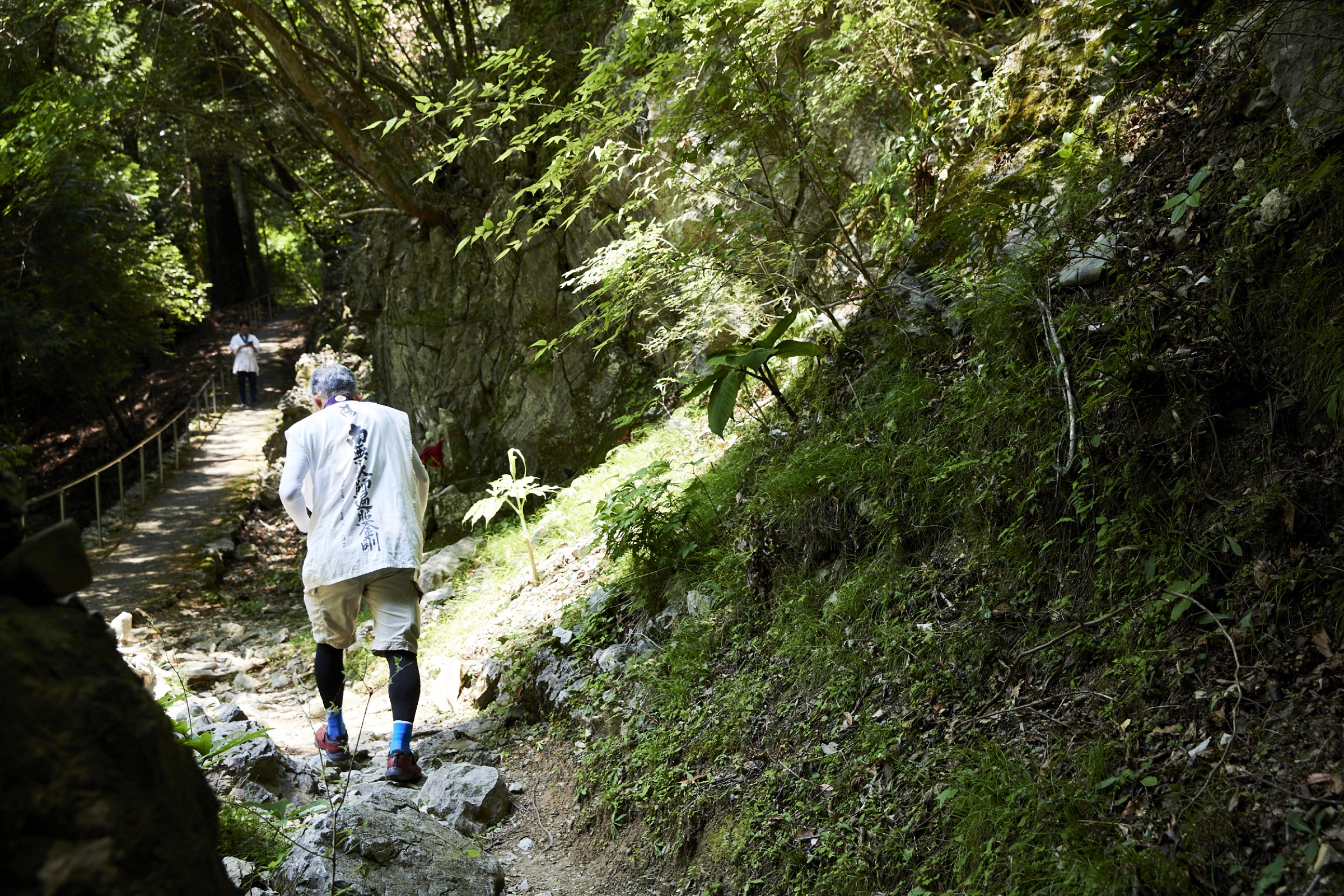
In front of the mountain gate of Ryōzenji, Temple 1, in Naruto, Tokushima. In the early morning air, two figures in white robes and sedge hats pass each other.
One is about to begin walking. The other has circled the whole of Shikoku and has just returned to this spot.
It is the same gate. The same sky. The same flagstones underfoot. And yet, for one of them, this is a beginning — and for the other, it is a place you hesitate to even call an ending.
The beginning and the end are the same point.
What kind of journey is this?
Look around the world, and most pilgrimages have an endpoint.
In northwestern Spain, Santiago de Compostela holds a cathedral said to enshrine the remains of Saint James the Great. Pilgrims who have walked hundreds of kilometers from France or Portugal receive here a Compostela, a certificate of completion — a single sheet of paper in Latin bearing the walker’s name and the distance covered. Scholars still debate the historical truth of the 9th-century tradition that the saint’s bones were discovered on this spot, but no one doubts the weight it carries as an article of faith.
In Mecca, Saudi Arabia, stands the cube-shaped sanctuary of the Kaaba. Muslims gathered from around the world circle it counterclockwise seven times. Male pilgrims wear ihram, two seamless white cloths that erase class and nationality; women observe their own modest dress. Once the seven circuits are complete, the core rite of the Hajj — the greater pilgrimage — is finished.
The Temple Mount in Jerusalem carries deep meaning for each of the three Abrahamic traditions — Judaism, Christianity, Islam — and the form and intensity of pilgrimage differs greatly between them, but they share this: a religious gravity concentrated on a single point.
For most pilgrims, pilgrimage has meant arriving at “that place.” A point set down on the map, approached by drawing a line ever closer toward it.
So where is the endpoint of the Shikoku pilgrimage?
The question is hard to answer. Because the road in Shikoku is a road that returns.
A 1,142-kilometer circle
The pilgrimage route of the Shikoku 88 sacred sites runs approximately 1,142 kilometers.
Beginning at Ryōzenji (Temple 1) in Tokushima, it follows the coastline of Kōchi, crosses the mountains of Ehime, reaches Ōkubo-ji (Temple 88) in Kagawa — and returns once more to Ryōzenji.
This figure needs a note. Other guidebooks give 1,200 kilometers, or 1,400. The difference comes down to how far you count the okunoin — the sacred sites deep in the mountains attached to each main temple — and alternate routes. The 1,142-kilometer figure comes from careful surveys by the organizations across Shikoku’s four prefectures dedicated to preserving the pilgrimage paths, and it is the number most walking pilgrims rely on today.
1,142 kilometers is longer than the straight-line distance from Tokyo to Fukuoka (roughly 890 km). On foot, it takes an average of 40 days. Strong walkers manage around 35; those who go slowly can take more than 50.
The 88 temples — the fudasho, the sites you visit and pray at — are arranged along this route at roughly even intervals. Visiting two or three temples a day is a standard pace. The verb used for visiting a temple, utsu (“to strike”), comes from an old custom: pilgrims once nailed wooden or metal name-slips to a temple’s pillars or gate as proof of their visit.
Why 88? Several explanations exist side by side.
One, from Jakuhon’s 17th-century Shikoku Junrei Kudokuki, holds that the number comes from the “88 afflictions” described in the Buddhist text Abhidharmakośa — the delusions counted under the truth of accumulation within the Four Noble Truths. This is a separate numerology from the more familiar “108 earthly desires” of Mahayana Buddhism.
A folk explanation adds up the three unlucky ages — 42 for men, 33 for women, 13 for children — to reach 88.
Another notes that the characters for “88” (八十八) can be combined to form the character for “rice” (米).
And Ninshō Miyazaki proposed that ancient Japan regarded eight as a number of fullness, and doubled it with ten to form an auspicious 88.
None of these can be confirmed. But the very fact that multiple traditions offer competing explanations speaks to the symbolic weight this number carries.
Aruki Ohenro Monoshiribuchō (The Walking Pilgrim’s Almanac) describes the larger frame — the circle — this way:
The Shikoku pilgrimage, also called “O-Shikoku,” is a grand circuit of 88 sacred sites scattered across Shikoku, where Kōbō Daishi (Kūkai, 774–835) is believed to have trained. Is it not an act of approaching a state of enlightenment, surrounded by the treasures of the 1,142-kilometer road — the 88 temples, the nature and climate along the way, the stone Buddhas, the people?
What stands out is the phrase “a grand circuit” and the concrete figure of 1,142 kilometers behind it. The distance alone is grand. But it is the shape — a circle — that makes this journey stranger still.
This circle is not a neatly designed ring. It hugs the coastline, threads through mountain ridges, crosses rivers, passes through villages, winding according to the terrain. Seen on a map, it pinches inward here, bulges outward there — never a clean geometric O. And yet, tracing the 88 temples in order, the shape of “circling the island” clearly emerges.
The shape is vague. The structure is unmistakable. That, perhaps, is the first hint of what makes the Shikoku road so strange.
A journey with rules that are somehow not rules
What defines the Shikoku pilgrimage, even more than the distance, is its freedom.
Walk it. Or drive it. Take a bus tour. Ride a bicycle.
Go clockwise — this is called jun-uchi, “forward striking,” the standard route for beginners, and the one the signposts are built around.
Or go counterclockwise — gyaku-uchi, “reverse striking.” Folk belief holds that walking gyaku-uchi in a leap year triples your merit and makes you more likely to encounter Kōbō Daishi himself. It’s worth noting, though, that on closer inspection of the sources, this “tripled merit” reading appears to be a relatively recent belief that spread after route signage was developed in the 1980s — not a teaching from the classical tradition.
You need not complete the full circuit in one go. Some pilgrims visit the 23 temples of Awa (Tokushima) in year one, the 16 of Tosa (Kōchi) the next year, the 26 of Iyo (Ehime) the year after, and finally the 23 of Sanuki (Kagawa), reaching kechigan — completion of the pilgrimage — over four years. This is called kugiri-uchi, “sectioned striking.”
Even the starting point is free. You don’t have to begin at Temple 1.
The book Shikoku Henro puts this freedom plainly:
The Shikoku pilgrimage says: reverse or forward, it is fine either way. Begin wherever you like, end wherever you like. It is a journey that permits — that has, in a sense, no rules at all — and that welcomes and accepts this absence of rules.
“Rules that are somehow not rules.” Set against the world’s pilgrimage traditions, this reads as stranger still.
Consider the comparison.
To receive the Compostela on the Camino de Santiago, you need a verified record of having walked at least 100 continuous kilometers (or cycled at least 200), proven by stamps collected along the way at hostels (albergues).
The Hajj takes place on fixed days of a fixed month in the Islamic calendar, in a fixed sequence of rites — strict in both schedule and route.
Even within Japan, the Saigoku 33 Kannon pilgrimage is described as traditionally following roughly the order of its numbering, from Seiganto-ji (Temple 1) in Wakayama to Kegon-ji (Temple 33) in Gifu (see The Sociology of Henro and Pilgrimage).
Against all of this, Shikoku alone permits: begin wherever you like, circle in whichever direction, split it into as many trips as you please.
Perhaps “permits” is not quite the right word. More precisely: no rule can be established in any direction, because the very shape of the journey is a circle.
A circle carries no built-in beginning or end. Draw a full loop on a map, and any point on it can be called “first,” any point “last.” The structure itself declares this — no one needs to decide it.
The rules aren’t loose. The structure simply has no need for the form of a rule.
Not “pilgrimage” but “circuit-worship”
Here it is worth pausing on a single word.
The people of Shikoku rarely call the act of visiting the 88 temples “pilgrimage” (junrei). They call it junpai — something closer to “circuit-worship.”
This is not a trivial distinction.
Aruki Ohenro Monoshiribuchō writes:
The Shikoku pilgrimage allows multiple ways of circuit-worship, suited to each pilgrim’s circumstances. This is because the Shikoku pilgrimage is a circulating pilgrimage that goes around an island, with its 88 temples arranged in a parallel relationship along that circle. Being circulating in nature, it becomes a journey without end. This distinctive form may be why it is called junpai rather than junrei — perhaps to mark the very identity of the Shikoku pilgrimage.
On the dictionary level, the gap between junrei and junpai is slight. But what the author is pointing to, read this way, is something built into the word itself — a reference to structure.
Junrei carries the nuance of “circling toward” and then “paying respect at” a holy place. There is, in the end, a single object of worship.
Junpai carries the sense of worshipping each place, in its own place, as you go. Not a movement toward a center, but a movement along a circle.
Because this is a journey with no endpoint, it cannot be called by a word — junrei — that implies moving toward one. Hence, junpai.
The language mirrors the structure.
And the phrase the book uses — “a parallel relationship” — points to one more essential property. The 88 temples are not arranged in a hierarchy or ranking. They sit in parallel along the circle. None is the lead role, none the supporting one.
Temple 1, Ryōzenji, is the starting point — but that does not mean it is “the most sacred.” Temple 88, Ōkubo-ji, is the destination — but that does not mean it is “the ultimate holy site.” For a gyaku-uchi pilgrim, Temple 88 is simply the temple just before Temple 1 in the sequence.
The standing of a temple shifts with the direction you walk. Or, perhaps, it was never fixed to begin with.
This is a theme we will return to in depth in Part 6 — but worth holding in mind even here, in the opening chapter.
The circle itself, as a shape, carries meaning
A circular road is not simply a road “without a destination.”
Aruki Ohenro Monoshiribuchō sees meaning in the circle itself, as a form:
This strange, circular shape means the infinite, the complete, the eternal.
Infinite. Complete. Eternal. None of these words carries the concept of an ending.
A straight line has a beginning and an end. It is a shape built for setting a goal and reaching it.
A circle has neither beginning nor end — or rather, it has countless beginnings and countless endings. Any point can be a start. Any point can be a finish.
Daily life mostly runs in straight lines. Monday to Friday. April to March. Birth to death. We set destinations, choose the shortest path, think in terms of efficiency.
Shikoku Henro describes this ordinary life as “a two-dimensional life, moving the shortest distance because there is a destination” — life spread flat across a map, moving by the shortest route from point A to point B.
Against this, the same book describes the Shikoku pilgrimage as “a journey lived on the surface of a spherical, three-dimensional earth, within eternal time — a fourth dimension — so that you come to feel four dimensions in your body.”
Not a circle drawn on a flat map, but a circle etched into the surface of a solid, three-dimensional earth. Stand at Cape Muroto and look out over the Pacific, the book says, and you can feel it: the curve of the horizon out over the water tells you, directly, that the earth is indeed a sphere.
“Four dimensions” is the book’s own figure of speech. But what it is reaching for is clear: a journey lived inside a sense of time given no direction, never arriving at an end.
The gravity called “Shikoku sickness”
And something strange is reported to happen to those who place themselves inside this circular road.
Aruki Ohenro Monoshiribuchō puts it this way:
The urge to set out on the pilgrimage again is called “Shikoku sickness.” This sickness is a bit troublesome. Its symptom is a restlessness that follows you outside Shikoku. And when you take up the pilgrimage again on Shikoku soil, a sense of peace comes over you, as if you were somewhere you truly belong — almost as if it connects you back to your mother’s womb, the Taizōkai (womb realm).
Taizōkai is a term from esoteric Buddhism — a world that holds all life within it, the way a womb does (we will treat this in more depth in a later chapter). The slippage between metaphor and doctrine is itself part of what makes this passage so interesting. In this tradition, the mother’s womb and the cosmic womb realm are not two separate things joined by analogy — they are a single fact, seen at two different scales.
What stands out is this: many who complete a full circuit of Shikoku report not the satisfaction of having finished, but a feeling of “I want to begin again,” “I want to be back inside this circle.”
This kind of feeling is not unheard of even in destination-based pilgrimages. People who reach Santiago often say “I want to walk it again” too. But that, one imagines, is closer to wanting to relive that particular feeling of arrival — a desire to replay the achievement.
In Shikoku, the reported feeling seems to differ. Not “achievement, once more,” but “I want to stay inside that circle” — “I feel unsettled once I leave it.” Something closer to a desire to remain.
Calling this “Shikoku sickness” — a phrase both faintly humorous and quite deep — is perhaps a name that the land of Shikoku itself produced, over a very long stretch of time.
The word “sickness” usually implies a wish to be cured. But “Shikoku sickness,” as the same book notes, comes with the admission: “and you don’t even want to be cured.” A sickness you don’t want to cure.
Perhaps it isn’t a sickness at all — perhaps it’s a kind of gravity, one that remains only in those who have once known the circular journey.
Carrying three questions
By now, an outline should be visible.
The Shikoku pilgrimage is a circular road. No endpoint, a free starting point, a free direction, a free number of visits — a journey that leaves you wanting, once you return, to begin again.
This occupies an extremely unusual position on the world map of pilgrimage. It differs in structure from the Camino de Santiago, a UNESCO World Heritage route, from the Hajj, from pilgrimage to Jerusalem.
And this strangeness is not incidental. Perhaps it is precisely because there is something meaningful in the circular shape itself that this road has drawn people for over a thousand years.
So, as this series — “The Circular Path: Shikoku 88, Secrets of a Pilgrimage Without End” — begins, we want to carry three questions as we walk.
One: Since when has the circle been a circle? Who designed this circular road, and when? Or was it never designed by anyone — simply worn smooth, naturally, over a very long time?
Two: What does the shape of a circle actually mean? Equality. Eternity. Wandering. Mandala. Reincarnation. Death and rebirth. Dōgyō ninin — “two travelers, one path” — the distinctive Shikoku belief that even a pilgrim walking alone is accompanied by Kōbō Daishi. Why do these concepts converge on this particular road in Shikoku?
Three: What does it say to us, today? Living as we do inside linear achievement, linear progress, a linearly planned life — what does the circular road have to offer us?
Over the fourteen installments ahead, we will unravel these questions one at a time.
The Camino de Santiago, the representative linear pilgrimage. The Kumano pilgrimage, which chose a third form — neither line nor circle. A chapter that digs into historical sources to trace the beginnings of the circular road. And, in turn, the equality, the sense of time, the self, death and rebirth, the wisdom of polytheism, and the culture of osettai — the uniquely Shikoku custom of offering food or lodging, free of charge, to passing pilgrims — that the circle makes possible.
By the final installment, when we stand once more before this gate, the editors believe something will have changed in us from who we were the first time we stood here.
So — let’s return, once more, to the front of Ryōzenji’s mountain gate.
A pilgrim setting out, and a pilgrim who has returned, pass each other at the same gate. What kind of moment was that? The answer will come, over the course of a year.
Series: “The Circular Path — Shikoku 88: Secrets of a Pilgrimage Without End”
- Part 1: Why Do People Keep Walking a Pilgrimage With No Finish Line? (this article)
- Part 2: A Pilgrimage Drawn in a Single Line — What the Camino de Santiago Teaches Us
- Part 3: The Third Way of Kumano — Between the Line and the Circle
To walk this road, and to stay a while, at a working shukubo on the Shikoku pilgrimage: Stay at Shukubo / About Temple Stay.